
News
Keep up-to-date with the latest NHS Benchmarking Network developments and news!
On this page you will find NHSBN wide and member programme news. For news from our other programmes, please follow the links below:
-
Below are our latest NHSBN wide newsletters. To join our mailing list, please contact us.
Building a sustainable international mental health network
The NHS Benchmarking Network had the pleasure of co-hosting a virtual mental health leadership exchange meeting with our colleagues at the Global Leadership Exchange.
The NHS Benchmarking Network had the pleasure of co-hosting a virtual mental health leadership exchange meeting with our colleagues at the Global Leadership Exchange. The virtual meeting formed part of the 2024 Global Leadership Exchange titled ‘Leading Change: Flourishing Communities and Wellbeing for All’ taking place this year in Utrecht, Netherlands from 24-28 June. The GLE Exchange takes place every two years providing an opportunity for international leaders to come together to discuss best practice in mental health leadership from across the globe.
The NHS Benchmarking Network has worked with international colleagues to create and deliver an international mental health benchmarking report/dashboard to support international comparison and knowledge exchange since 2016. However, given the significant and wide reaching impact of the pandemic on those who commission, use, and deliver mental health services the match this year was a timely opportunity to pause and review the future of the international benchmarking work. The leadership exchange this year presented us with an opportunity to explore with international colleagues how to co-develop a longer term sustainable international benchmarking collaborative to create regular opportunities for networking, shared learning of best practice in mental health leadership, and data collection and resource development to support quality improvement, service development and transformation programmes.
The theme of our meeting this year were therefore titled ‘Developing a sustainable international mental health benchmarking collaborative’ and we were delighted that 19 colleagues from across six countries were able to join the virtual meeting with more colleagues attending the full Leadership Exchange in Utrecht. As part of the virtual meeting colleagues shared challenges in their respective systems, priority areas, and ideas about how to structure and design a more formalised network moving forward. We were particularly grateful to Swedish and UK colleagues who shared how benchmarking data from the international project work generated curiosity and generated lines of enquiry which lead to a UK-Swedish exchange of colleagues working in children and young people’s mental health services. The benchmarking work has continued to inform local and wider thinking about delivery of children and young people’s mental health services.
This year marks the start of what we hope will become an evolving international mental health benchmarking network. We look forward to working with GLE and international colleagues between now and the next Global Leadership Exchange in Canada in 2026, and sharing the learning with our vibrant benchmarking community in the UK.
Please find links to previous international benchmarking projects here: https://www.nhsbenchmarking.nhs.uk/international
End of Life Clinical Audit Celebrated in National Awards
National Audit of Care at the End of Life (NACEL) is in the spotlight this week, as part of a national campaign to underline the importance of clinical audit and quality improvement in enhancing patient care.
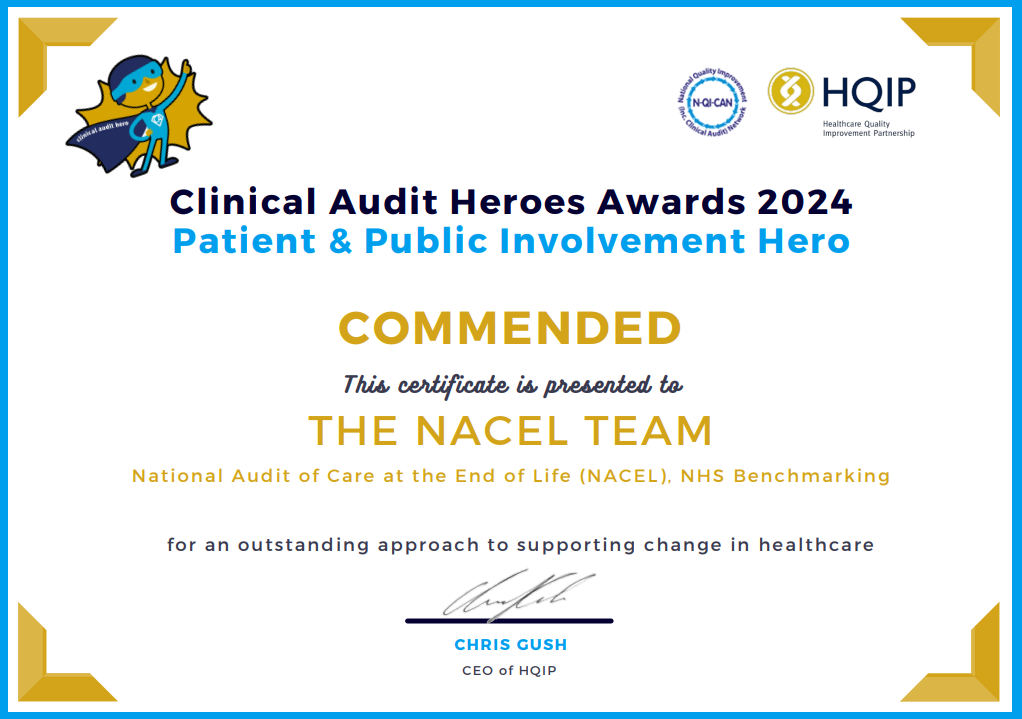
National Audit of Care at the End of Life (NACEL) is in the spotlight this week, as part of a national campaign to underline the importance of clinical audit and quality improvement in enhancing patient care. They have been announced as a commended entry in the Patient & Public Involvement category of the Clinical Audit Heroes awards, which are an integral part of Clinical Audit Awareness Week.
They were recognised for a project which directly sought the views and experiences of bereaved people in the design of an audit tool. The judges were impressed, not only with the support available to patients and carers, but also the on-going process of feedback. There was involvement from the very beginning, and this was clear from the impact demonstrated.
Jessica Moss, Quality Improvement Lead for NACEL at the NHS Benchmarking Network, said: “We are delighted to be recognised in the Clinical Audit Heroes awards. By taking an evidence-informed approach to improvement, clinical audits help to target change where it will have the greatest impact. Thank you to all the participants in the bereaved persons focus groups for sharing their experiences as well as The Patients Association (@PatientsAssoc) and Nikki Archer for collaborating with us on this project.”

Clinical Audit Awareness Week is hosted by the Healthcare Quality Improvement Partnership (HQIP) in collaboration with the quality improvement network N-QI-CAN, and runs from 24-28 June 2024. It is designed to celebrate the role of clinical audit and quality improvement in improving healthcare services.
More specifically, clinical audits review and measure healthcare, often in relation to local and national standards and targets. They are an effective way to determine if services are performing as they should and, if not, identify where changes are needed. They also help healthcare providers and patients alike to understand how their service is performing, and where improvements could be made. As such, the work of clinical audit teams is essential, both as drivers of improvement in their own organisations and in supporting scrutiny of our health system at a national level.
Chris Gush, CEO of HQIP, explains: “Without clinical audit, we would lack the necessary insights to understand what is working well and, crucially, what is not. By measuring our healthcare services and tracking the differences that improvement activities make, clinical audits are directly contributing to saving and improving patients’ lives.”
For more information on the national clinical audits that are commissioned by HQIP on behalf of NHS England, go to www.hqip.org.uk/national-programmes; to see their findings, view the reports published on a wide range of clinical disciplines, ranging from asthma and diabetes to cancer and cardiovascular disease.
Find out more about Clinical Audit Awareness Week and the Clinical Audit Heroes awards on the HQIP website.
You can also join in the celebrations on social media using #CAAW24.
NB: HQIP is an independent organisation that works in partnership with patients and healthcare professionals to influence and improve healthcare, through clinical audit and evidence-informed quality improvement. They commission the National Clinical Audit and Patient Outcomes Programme (NCAPOP) on behalf of NHS England.
Clinical Audit Awareness Week is a national campaign spearheaded by Healthcare Quality Improvement Partnership (HQIP) and the National Quality Improvement (including Clinical Audit) Network (N-QI-CAN). More information is available at: www.hqip.org.uk/clinical-audit-awareness-week. The social media hashtag is #CAAW24.
Enquiries: communications@hqip.org.uk.
Blog post: International Collaborative Summer School
Find out what happened when Dr Mary Miller, Dr Rosie Bronnert and Jess Moss from the NHS Benchmarking Network attended the International Collaborative for best care for the dying person Summer School 2024 in Malaga, Spain.
The International Collaborative for best care for the dying person Summer School took place on 13th and 14th May 2024. The international group were hosted by Cudeca Hospice (Malaga, Spain) in their state of the art educational centre. The school was hosted by Dr Marisa Martín Roselló and her team who were superb hosts, supporting learning, discussion and collaboration in the warm sunshine. The international collaborative brings together a global group of leading thinkers, practitioners and researchers, who share a vision for a world where all people experience as good death as an integral part of their individual life, supported by the very best personalised care.

Dr Rosie Bronnert, (bottom right, blue top), Dr Mary Miller (bottom right, red cardigan) and Jess Moss (bottom right, white top) representing the NHS Benchmarking Network
Day 1:

Jess’s poster was accepted for presentation: ‘Learning from loved ones’ involvement in the re-design of the National Audit of Care at the End of Life (NACEL)’.
Dr Marisa Martín Roselló and Mr Yusuf Hamied welcomed the group to the summer school 2024. Professor John Ellershaw outlined the programme for the school and outlined the work of the international collaborative. Dr Agnes Van der Heide led the plenary, discussing key findings of the EU Horizon iLIVE project.
The NHS Benchmarking team participated in the ‘Benchmarking in the Care of the Dying’ workshops, one of four workshop streams that ran throughout the day. The team were invited to present on each of the three themes:
Different models of benchmarking for care of the dying across the world: Dr Mary Miller
Quality improvement in the context of national benchmarking: Dr Rosie Bronnert
Perceptions of staff and relatives on care of the dying person from use of questionnaires: Jess Moss
The NHS Benchmarking team were privileged to showcase NACEL as one of the two major global success stories.
Day 2:
Dr Marisa Martín Roselló welcomed the delegates back for a second day. We heard about palliative care in intensive care departments in low resource settings in the plenary before moving on to invited oral presentations. Dr Mary Miller spoke about the ED results from the NHS Benchmarking pilot of the redesigned case note review (2023). Three other presenters discussed work from Ireland, the United Kingdom and Germany.
The NHS Benchmarking team participated in workshops looking at global research on benchmarking. Dr Claudia Fisher presented a very interesting systematic review looking at the impact of benchmarking on improving care.

Dr Mary Miller presented the current research outputs of NACEL and a vision for the future. Delegates worked in collaboration to pull together an outline proposal for EU funding – a call for applications is awaited with eagerness! The school drew to an end with reflections and learning led by Professor John Ellershaw.
As well as providing an opportunity to showcase the work of NACEL and NHS Benchmarking, the team met colleagues seeking to introduce benchmarking (Malta, Iceland and South America), learned about international practice (Sweden and Australia) and learned about the vision to improve care at the end of life by measuring practice and using knowledge to undertake quality improvement. The summer school was a fabulous networking and learning experience – now to decode and capture my notes and reflections.
In celebration of Community Nursing NHSBN’s Karen Rix interviewed Aaron Watts, Community Nurse at Norfolk Community Health and Care NHS Trust
In celebration of International Nurses Day 2024, the NHS Benchmarking Network were delighed to sit down and interview Aaron Watts, Community Nurse at Norfolk Community Health and Care NHS Trust

Karen: Today, we are delighted to have Aaron Watts, Nurse at Norfolk Community Health & Care (NCHC), joining us for an insightful conversation about how he is using benchmarking data in his role and how this is supporting his practice and his trust. Welcome, Aaron and thank you for taking the time to speak with the NHS Benchmarking Network.
Aaron: Thank you for the opportunity. It's a pleasure to be here.
Background
Karen: Please could you tell me a bit about your current role and experience.
Aaron: I have been working for NCHC since September 2019. I started as a trainee nursing associate, studying, and working throughout covid to reach my qualification as a registered nursing associate. Since then, I have been upskilling on the nursing degree apprenticeship course and will reach Band 5 this October.

I have a particular interest in wounds and take pride in providing person focused care in the community. My role allows me to use my clinical skills in patient’s homes, I am gaining lots of experience in many areas of community nursing. I am grateful to my trust for funding both of my courses, I aspire to continue my learning with a master's degree and hope to reach Band 6 as soon as possible.
Benchmarking data and Norfolk Community Health and Care NHS Trust
Karen: Thanks for sharing your journey so far Aaron. Could you outline how benchmarking data is used in NCHC and healthcare more broadly, with a particular focus in nurse education.
Aaron: Benchmarking data provides an insight into the metrics and statistics of patient care. As a community nurse there is particular value in this data being utilised in the provision of care. Such value comes from understanding influences and general trends of your trust and teams and then using this in comparison to others. If certain areas highlight your team as an outlier this can allow for investigation and lead to service improvements.
Karen: Are there any specific areas or processes that you find benchmarking data most valuable?
Aaron: The sheer volume of data and information accessible is valuable, comparing ICB’s is also of interest. I have only recently gained access to the NHSBN (NHS Benchmarking Network) Futures forum, but the prospect of raising questions in this format also seems valuable.
Karen: That’s great thank you, I am keen to understand the limitations you experience in accessing benchmarking data to support your practice.
Aaron: I have recently started to utilise data in my practice. The problem I have found is the data is often at a higher level than what is accessible for myself as a community nurse. Seeing data specific to clinical care plans, such as pressure ulcers, wound care, compression bandaging, bladder washouts, catheters, etc., would allow insight into trends and data that I could use frequently. For example, understanding if certain areas in my trust have low caseloads of bladder washouts or if my team retains pressure ulcers longer on average than other localities.
Karen: Have you encountered any challenges in utilising the benchmarking data you have accessed in your practice? If so, how have you overcome them?
Aaron: The main challenge encountered is finding the time to locate the data that is relevant to my practice. With my clinical lead and clinical operations manager understanding the value of data and seeing its implementation can be beneficial to the team, there has been capacity created in order to dig into the data held by NHS Benchmarking Network. Currently the data is providing opportunities for thinking about quality improvements and changing practice for the better. I would like to see more specific data, as noted previously, regarding individual practices. These niche parts of data could provide insight at a level that is more accessible for front line staff.
Benchmarking data and its contribution to Quality Improvement
Karen: How does benchmarking data contribute to quality improvement initiatives within your area of interest and/or your Trust, do you have examples you can share?
Aaron: I am investigating introducing wound care training that can be utilised by clinical leads and clinical operations managers to give to new staters and colleagues who request further training. There are E-learning and tissue viability courses that are accessible, but these are underutilised. Often, it's the case that community nurse wound care skills and knowledge is developed over experiential training rather than any formal education. Our QI project is addressing this by changing the approach.
I am currently investigating, with the aid of my clinical lead, a general trend of retaining diabetic patients on our caseload longer than others in our wider region. This may be as a result from requiring more diabetic education for nurses or patients or implementing a wider range of diabetic management equipment to promote greater autonomy with some of our diabetic patients. This study has arisen from benchmarking data and may lead to improved patient wellbeing. Data highlighting wound care caseload, QOF prevalence, mean visits, resource allocation etc., could be beneficial for my investigation. I am interested in determining why my locality has an above than average prevalence of diabetes and if there are any improvements we can make in reducing our caseload and promoting patient wellbeing.
Karen: I would be really keen to hear more about this after your investigations, I am sure our readers would also be keen to hear more.
Aaron: Absolutely! We can follow up once they’re complete.
Feedback processes
Karen: Just a few more questions before we end, how do you communicate findings from benchmarking data to your colleagues or leadership teams?
Aaron: Disseminating the information is fed upwards to my clinical lead who utilises quarterly newsletters or emails to our wider team.
Karen: Are there risks of sharing benchmarking data with staff?
Aaron: Staff engagement would be the only risk. With low capacity and straining resources, nurses might not engage with the data being sent, having to focus on their day-to-day job.
Closing statements
Karen: Finally, do you have any content or areas you would like to include? Anything else to share with our readers?
Aaron: As noted, although I’m not sure if there is any realistic way to collect this data, more specific data regarding clinical care plans.

Karen: Thank you so much for sharing your insights into the data with us, Aaron. It has been a pleasure speaking with you and I wish you every success with your career.
About your interviewer
Karen Rix, Associate Director, Network Development and ICB (Integrated Care Boards) Sector Lead
Karen joined the Network in November 2022 and heads the Network Development and ICB teams. Karen previously spent 18 years working within the NHS. As a Deputy Director, Karen gained a wealth of experience in mental health service provision, transformation, commissioning, and performance.
Karen's passions lie within quality and patient focused services. Karen has a strong record of using data and technology to bring about sustainable change and improved patient outcomes.
You can find information benchmarking data relevant to this article in the Members Area community indicators pages and the IC Benchmarker.
Interested in sharing how your organisation has used the data? Contact us, we would be thrilled to write a case study, have an interview or just a chat!
A Day to Remember: NHS Benchmarking Network – Celebration of the Network
The much anticipated ‘Celebration of the Network’ event took place at the Birmingham Conference and Events Centre last week (16/05/24).

The highly anticipated ‘Celebration of the Network’ event took place at the Birmingham Conference and Events Centre last week (16/05/24). The Network were delighted to welcome member organisations from throughout the UK.
For the first time ever, we welcomed virtual delegates through a hybrid system, with over 30 delegates joining online, all coming together to celebrate the excellent and ground breaking difference that benchmarking can make.
Bringing together NHSBN members and the Network Support Team, the event celebrated how Network data is being utilised by members and also recognised the valuable contribution made by member organisations.

The event kicked off with host Sam Wilde, Co-Chair of the Network Steering Group, setting the scene by highlighting the importance of benchmarking data within his own trust, Lincolnshire Community Health Services NHS Trust. Sam emphasised what Network data can bring to a trusts strategy long term.
One of the days most anticipated moments was the first ever NHSBN award ceremony. Network Director Sarah Atkinson and event host Sam Wilde presented five awards. Four awards recognised members contribution to the Network. These awards winners were chosen by taking into account many factors: participation in Reference Groups, member programme projects and support with NHSFutures, project scoping and code testing. The fifth award recognised the personal achievements of one member of the Network support team, Aidan Rawlinson, Product Developer.
Congratulations to our winners:
Midlands Partnership University NHS Foundation Trust
Rotherham Doncaster and South Humber NHS Foundation Trust
Mid and South Essex NHS Foundation Trust
Nottinghamshire Healthcare NHS Foundation Trust
Aidan Rawlinson, NHS Benchmarking Network

Throughout the day, attendees had the opportunity to network and share ideas with peers. Four guest speakers led the way by sharing how their Trusts have used the benchmarking data. Thank you to our guest speakers:
Samantha Steeples, Information Quality Officer at Rotherham Doncaster and South Humber NHS Foundation Trust - Samantha discussed benchmarking in practice, a view from her own organisation. The presentation received interest during the day, particularly around the Trusts top tips NHS Benchmarking Policy.
Ursula James, Associate Director for Mental Health at NHS England - Ursula presented how benchmarking data had supported Systems within South West England. Ursula outlined conclusions from some of the regions bespoke projects undertaken by NHSBN. These conclusions included empowering, enabling and equipping Systems to deliver on population needs following the South West Perinatal Mental Health Services project.

Sheila O’Loughlin, Head of Home Pathway, Vicky Robinson, Therapy Team Lead and Paul Drury, Director Urgent Community Response Care Group at Bromley Healthcare CIC Ltd - Bromley Healthcare CIC kicked off the event's afternoon session with a presentation focused on Intermediate Care and how the CIC has used their Intermediate Care data.
Phil Horner, Deputy Chief Strategy & Improvement Officer at Lancashire & South Cumbria NHS Foundation Trust - Phil rounded off the day with a presentation on building on benchmarking within the Trust.
As the event drew to a close, attendees left feeling enriched and eager to apply insights with new connections gained. The success of this year’s event sets the foundations for future celebrations of the Network, as we continue to recognise the invaluable contribution and commitment from our members.
Thank you to everyone who joined us on the day, in particular our guest speakers and award winners. We hope to see many of you at our future events, whether that’s in person or virtually.
For more information and to stay updated on upcoming events, visit https://www.nhsbenchmarking.nhs.uk/events.
NACEL launch Data and Improvement Tool (DIT)
We are pleased to announce the launch of the NACEL Data and Improvement Tool(DIT) and the reporting of the Quality Survey findings.
The NACEL team are pleased to announce the launch of the NACEL Data and Improvement Tool (DIT) and the reporting of the Quality Survey findings.
All organisations participating in NACEL 2024 can access the Data and Improvement Tool to review their initial Quality Survey findings. To date, NACEL has received 1,076 Quality Surveys from the bereaved.

The tool will display the Quality Survey findings for participating providers, showcasing each organisation’s position against the national and regional peer group. The Data and Improvement Tool has launched as a beta product, with an expectation that developments will be made between now and July 2024.
As more Quality Survey data is submitted, the Data and Improvement Tool will update to enable real-time reporting of the findings.
Find out how to access the Data and Improvement Tool by following this link https://www.nacel.nhs.uk/how-to-access-the-Data and Improvement Tool
NACEL Quality Improvement Webinars
Need help understanding the Data and Improvement Tool and how to translate data into quality improvement?
Mark your calendar for the first NACEL Quality Improvement webinar taking place on Thursday 9th May, 1pm – 2pm, via MS Teams.
Need help understanding the Data and Improvement Tool and how to translate data into quality improvement?
Mark your calendar for the first NACEL Quality Improvement webinar taking place on Thursday 9th May, 1pm – 2pm, via MS Teams.
The webinar will focus on how to use the NACEL data for quality improvement, including how to navigate the Data and Improvement Tool. We are delighted to have Dr Sarah Mitchell, NHS England's National Clinical Director for End of Life Care, as a guest speaker.
Register for the webinar here: https://www.nacel.nhs.uk/events/nacel-quality-improvement-webinar
Watch this space or keep an eye on our website for lunch time drop-in sessions happening on the 14th and 16th May to answer any questions and support the use of the Data and Improvement Tool.
For more information about NACEL please visit our website https://www.nacel.nhs.uk/
Unveiling the new NHSBN website and NHSFutures Workspace
Following the launch of the 2024/25 Member Work Programme on 11th April 2024. The NHS Benchmarking Network is delighted to unveil its highly anticipated new website, NHSFutures Workspace and new look members’ area.
Following the launch of the 2024/25 Member Work Programme on 11th April 2024. The NHS Benchmarking Network is delighted to unveil its highly anticipated new website, NHSFutures Workspace and new look members’ area.
Website

Taking onboard the feedback we received in our annual member survey, we have developed an easy to navigate, exciting and resourceful website to meet the needs of our members. Whether you're seeking membership information, member project details, the date of an upcoming event or simply to access our members’ area, we have you covered.
You’ll notice several changes to our site compared to the old site. We’ve updated the navigation and refined the categories to focus on our core elements. You’ll now also find our events under the ‘What we do’ section, and an events calendar to allow you to see all the upcoming events more easily.
To explore the new website and experience all of its new features, visit https://www.nhsbenchmarking.nhs.uk/ today!
Members’ area
Our members’ area has also seen some updates including:
Projects that your organisation has registered for will now be displayed first under ‘your current projects’ on the home page
Information on the project stage (e.g. ‘data collection closes in 14 days’).
The introduction of a sector filter and search box to make it easy for users to find projects of interest.
The left-hand side of the home screen now shows upcoming events, resources and the new NHSFutures workspace.
A resources page which pulls together the resources from across the Network projects into one easy access area. Resources found here include project overview reports, infographics, case studies and event documents.
NHSFutures Workspace
Feedback received in the member survey and from consultation on our website Forum page, recommended that the Network should have its own NHSFutures workspace. We have now launched our NHSFutures Workspace, please take a look and let us know your thoughts (https://future.nhs.uk/BenchmarkingNetwork).

The workspace aims to bring together individuals from our member organisations to network and collaborate with each other as well as with the Network’s Support Team. We encourage you to participate and generate discussion topics in our dedicated sector forums, sharing how you have used Network data for good practice.
On the left hand side of the workspace homepage, you’ll see our resources and forums. We have broken these down by sector and we welcome thoughts on whether a further breakdown by project would be helpful.
To join our workspace: follow this link https://future.nhs.uk/BenchmarkingNetwork and click join at the top of the page. Once access has been granted, you’ll be free to explore all the resources available. Over the coming weeks we will continue to add content to the site, so we encourage you to check back regularly.
Finally, we’d like to thank all of our members for their contributions and feedback to make these updates possible. If you have any feedback on the website, members’ area or NHSFutures workspace, please do get in contact at enquiries@nhsbenchmarking.nhs.uk.